For banks managing SME lending portfolios, the stock statement is not just a document. It is the foundation of working capital exposure. Every month, thousands of SMEs submit inventory and receivable data that directly impacts drawing power (DP), credit limits, and risk evaluation.
Yet in many banks, stock statement upload is still manual. Spreadsheets. Email attachments. Manual validations. Repeated calculations. This is where stock statement upload automation changes the equation. With AI-driven processing, banks can move from reactive, monthly reviews to intelligent, real-time monitoring.
In this blog, we explore how to automate stock statement upload in banking, the benefits of AI in stock statement processing, and how end-to-end stock statement workflow automation is transforming SME lending.
Why Manual Stock Statement Processing is a Structural Problem
Manual stock statement processing is not just slow. It introduces systemic risk.
When SMEs email stock statements, operations teams download attachments, review Excel files, manually extract figures, and calculate drawing power in spreadsheets. Every step depends on human intervention. This creates bottlenecks, especially when month-end submissions peak.
The larger issue is consistency. Different formats. Different templates. Missing data. Incorrect ageing classifications. The operations team must interpret each file manually, increasing variability and error risk.
Common challenges include:
- Manual data entry errors
- Inconsistent stock ageing interpretation
- Delays in drawing power calculation
- Limited cross-verification with ERP or GST data
- High dependency on spreadsheet formulas
In high-volume SME portfolios, even a 1–2% calculation error can significantly distort exposure levels. That is why banks are shifting toward intelligent document processing for stock statements and AI-driven validation engines.
Industry Pain Points
Manually uploading stock statements comes with its share of challenges and some of these are
- Time-Consuming: Manually uploading statements is tedious and prone to errors, taking up valuable time for both customers and bank staff.
- Accuracy Issues: Manual data entry can lead to errors and discrepancies, impacting investment tracking and portfolio analysis.
- Security Concerns: Sending sensitive financial documents through email or unsecured channels poses security risks.
- Limited Accessibility: Not all customers have access to scanners or the technical knowledge to upload statements electronically.
- Complex Calculations: The banking operational team has to do multiple calculations of the current account receivables, payables, and stock levels. Even a single error in the calculation can lead to multiple discrepancies.
How to Automate Stock Statement Upload in Banking
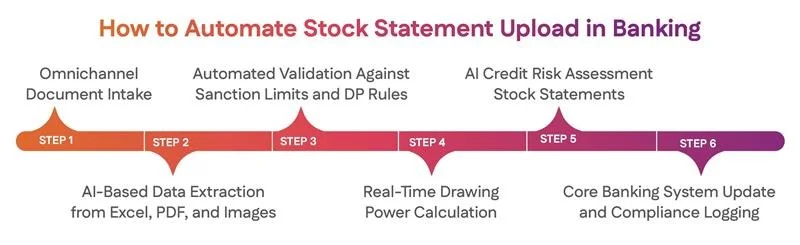
Modern AI systems enable complete automation of stock statement workflows. The shift is not incremental. It is architectural. Let us walk through the step-by-step workflow of stock statement automation in banking.
-
Step 1: Omnichannel Document Intake
- Capture stock statements via email, portal, WhatsApp, or API
- Auto-classify and route documents for processing
- Eliminate manual downloading and sorting
- Foundation of SME stock statement automation banking at scale
-
Step 2: AI-Based Data Extraction from Excel, PDF, and Images
- Use agentic AI for automated financial data extraction
- Extract stock value, WIP, finished goods, receivables, payables
- Understand financial tables beyond basic OCR
- Normalize data into banking-standard formats
- Enable banks to automate stock statement upload with AI
-
Step 3: Automated Validation Against Sanction Limits and DP Rules
- Apply sanction terms and margin rules automatically
- Exclude ineligible inventory
- Adjust debtor ageing thresholds
- Check sanctioned limits
- Remove spreadsheet dependency
-
Step 4: Real-Time Drawing Power Calculation
- Perform automated drawing power calculation using AI
- Apply margins and creditor adjustments instantly
- Enable real-time stock statement monitoring for loans
- Shift from monthly review to continuous exposure management
-
Step 5: AI Credit Risk Assessment Stock Statements
- Strengthen AI credit risk assessment stock statements workflows
- Compare trends across months
- Detect inventory volatility
- Identify receivable ageing shifts
- Flag deviations from benchmarks
-
Step 6: Core Banking System Update and Compliance Logging
- Auto-update core banking systems with validated DP
- Log rule applications and exceptions
- Ensure audit readiness and regulatory transparency
Manual vs AI-Based Stock Statement Processing
The difference between traditional workflows and AI-driven automation is not just about speed. It is about accuracy, risk visibility, and scalability. When banks compare both models side by side, the operational gap becomes immediately clear. AI transforms stock statements to upload automation from a manual back-office task into a structured, intelligent credit control mechanism.
| Aspect | Manual Process | AI-Based Process |
|---|---|---|
| Document Intake | Email-driven | Omnichannel automated |
| Data Extraction | Manual entry | AI-powered extraction |
| Validation | Spreadsheet checks | Rule engine validation |
| DP Calculation | Manual formula | Automated DP engine |
| Risk Monitoring | Periodic review | Real-time alerts |
| Scalability | Limited by staff | Portfolio-wide automation |
| Audit Trail | Partial | Fully logged and traceable |
The shift to AI-based processing reduces operational risk while enabling real-time stock statement monitoring for loans. More importantly, it supports end-to-end stock statement workflow automation at a portfolio scale.
Benefits of AI in Stock Statement Processing
When banks implement stock statements to upload automation, the impact is operational, financial, and strategic. First, processing time drops drastically. What previously required 20–40 minutes per statement can now be completed in a few minutes. This allows banks to process thousands of SME stock statements daily. Second, accuracy improves. AI eliminates manual data entry and ensures consistent rules of application across all accounts.
Third, exposure visibility improves. With end-to-end stock statement workflow automation, banks gain real-time insights into drawing power, stock movements, and debtor trends.
Key benefits include:
- Faster DP updates
- Reduced operational costs
- Improved regulatory compliance
- Scalable SME portfolio management
- Enhanced customer experience through self-service uploads
This is why the benefits of AI in stock statement processing extend beyond efficiency into risk transformation.
What Risk Signals Can AI Detect?
Manual reviews often miss subtle but important financial signals. AI workflow systems, however, analyze trends across time and accounts.
AI can detect:
- Stock value inflation before reporting cycles
- Aged inventory beyond threshold limits
- Debtor concentration risk exposure
- Sudden stock spikes before reporting date
- Mismatch with GST or ERP-reported data
These capabilities transform stock statement automation in banking from a processing tool into a proactive risk intelligence system.
The Future of AI in Stock Statement Financing
The future of SME lending is continuous, not periodic.
Instead of waiting for monthly submissions, banks are moving toward API-based ERP and GST data ingestion. Drawing power can be recalculated dynamically as inventory data changes.
Emerging capabilities include:
- Continuous DP monitoring instead of monthly reviews
- Predictive credit risk scoring for SMEs
- GenAI-based covenant monitoring
- Self-service SME upload portals with auto-validation
- Integration with supply chain finance platforms
This evolution positions AI as a core risk infrastructure layer in working capital financing.
How AutomationEdge Enables Stock Statement Automation
AutomationEdge delivers a structured approach to stock statement upload automation. Its solution includes AI-based document ingestion that captures files from multiple channels and standardizes them automatically. The drawing power auto-calculation engine applies sanction rules consistently and updates exposure in real time.
Integration with core banking systems ensures seamless synchronization, while exception workflow management routes flagged cases for human review only when necessary. Compliance-ready audit trails ensure regulatory transparency. The outcome is measurable: banks can process thousands of SME stock statements daily with near-zero manual intervention while improving risk visibility.
Core Capabilities
AutomationEdge enables stock statement automation through:
- AI-based document ingestion across email, portal, API, and messaging channels
- Intelligent document processing for stock statements (Excel, PDF, scanned images)
- Automated data normalization into banking-standard formats
- Drawing power auto-calculation engine aligned with sanction terms and margin rules
- Automated validation against DP policies and eligibility thresholds
Conclusion
Stock statement processing is no longer just an operational requirement; it is a critical control point in SME lending. As portfolios grow and regulatory scrutiny increases, manual uploads, spreadsheet-based drawing power calculations, and delayed validations create avoidable risk. The future of working capital finance lies in intelligent, end-to-end stock statement workflow automation, and the banks that move early will lead to speed, scale, and smarter risk management.
Frequently Asked Questions
The post Automating Stock Statement Upload in Banking with AI appeared first on AutomationEdge.
This is a companion discussion topic for the original entry at https://automationedge.com/blogs/stock-statement-upload-automation-with-ai/