The year 2026 will redefine how HR operates. With agentic AI in HR, generative AI, AI coaching platforms, and cloud-based HR systems accelerating, HR leaders must prepare for a major shift.
This blog explores the top HR trends for 2026, including agentic AI, generative AI-led employee experience, future-ready skills, AI-driven coaching, culture-powered performance, and data protection in cloud-based HR. These HR technology trends will help teams automate routine work, scale employee support, and build a high-performance culture through human-AI collaboration. With rising AI adoption, HR will shift from administrative tasks to strategic value creation.
What Is HR Technology and Why It Matters in 2026?
HR Technology refers to digital tools, platforms, and AI-driven systems that help HR teams manage people processes recruitment, onboarding, payroll, learning, performance, employee experience, and workforce analytics. It replaces manual work with automated, intelligent, and data-supported workflows that make HR faster, more accurate, and more strategic.
As we move toward 2026, HR technology becomes even more important because agentic AI, generative AI, cloud-based HR systems are reshaping how organizations operate. These trends demand modern tools that can automate repetitive tasks, personalize employee experiences, and ensure secure, compliant data management.
Power Tip for CHRO
As a CHRO, your biggest advantage is readiness. Invest in the right HR tech today, so your teams stay agile, strategic, and future-ready.
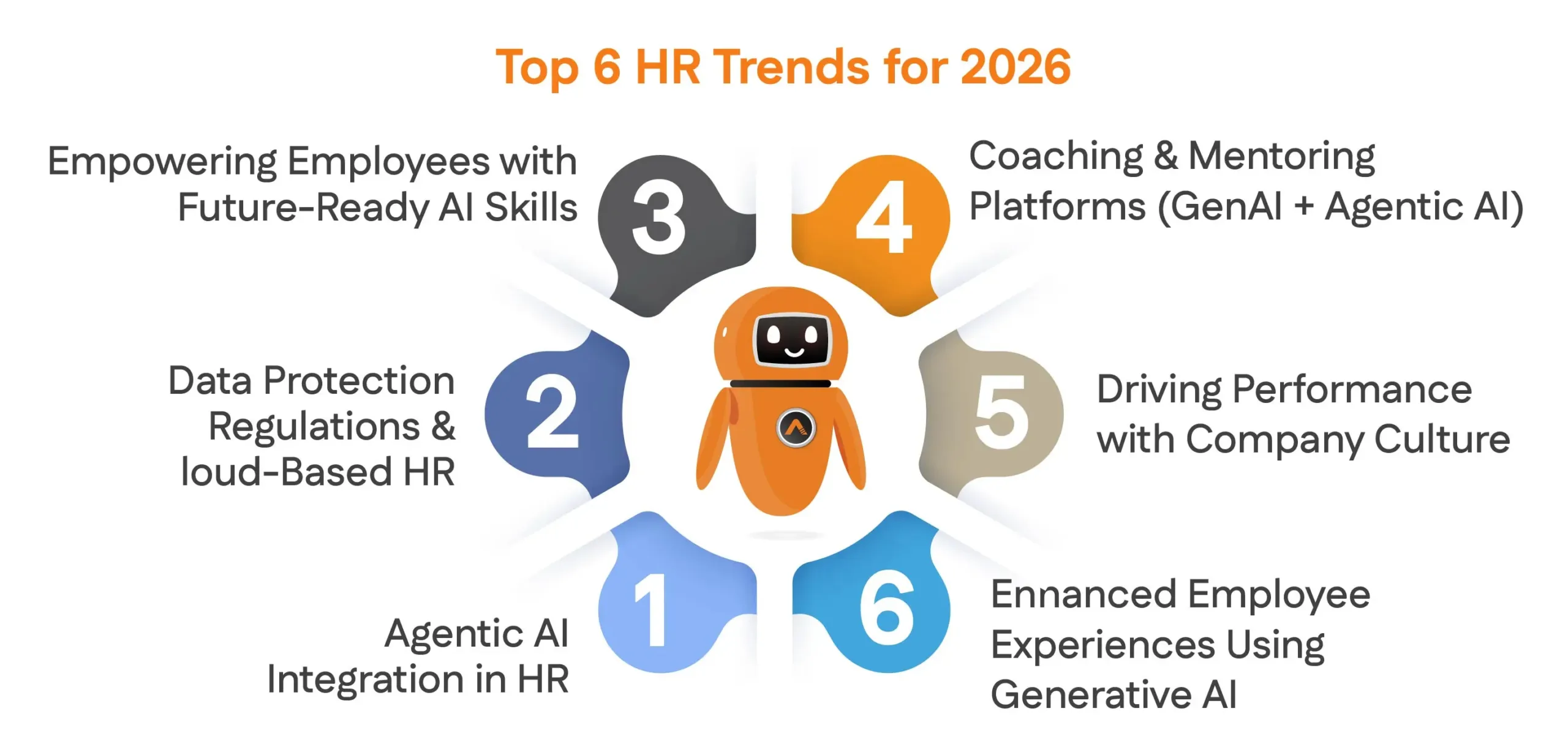
Top 6 HR Trends for 2026
Here are the six most important HR trends to watch in 2026.
-
Agentic AI Integration in HR
What it means:
Agentic AI in HR can act autonomously, planning, executing, and optimizing tasks without constant human input. In HR, this goes beyond simple chatbots or automated replies.Why it matters:
- It reduces manual work for HR teams.
- It accelerates onboarding, queries, and compliance tasks.
- It frees HR to focus on strategy, not just operations.
Example:
An AI agent notices that a new hire hasn’t completed their paperwork and automatically sends reminders, fills up forms, and follows up without a human needing to intervene. -
Data Protection Regulations & Cloud-Based HR
What it means:
As HR systems use more AI, data protection and cloud infrastructure become critical. Companies will move to cloud-based HR tools that support secure data governance and comply with regulations.Why it matters:
- Employee privacy is protected.
- Organizations avoid regulatory fines.
- AI systems run on trustworthy, enterprise-controlled infrastructure.
Example:
A company moves its onboarding system to a protected cloud platform where AI can verify documents securely without exposing personal details. -
Empowering Employees with Future-Ready AI Skills
What it means:
HR will invest more in reskilling programs so employees can work effectively alongside AI. Skills like prompt engineering, data literacy, and human-AI interaction will become core.Why it matters:
- It ensures that the workforce remains relevant.
- Employees become co-pilots, not just users.
- It drives higher adoption and trust in AI systems.
Example:
A retailer’s sales team takes weekly micro-lessons on how to prompt and interpret AI outputs, enabling them to use AI agents to draft emails, analyze customer data, or suggest cross-sell ideas.
-
Coaching & Mentoring Platforms (GenAI + Agentic AI)
What it means:
Learning management systems (LMS) and coaching platforms will integrate both generative AI and agentic AI to deliver mentoring, feedback, and skill paths automatically.Why it matters:
- Managers no longer have to manually coach everyone.
- Employees receive real-time, data-driven suggestions, increasing employee engagement through participation in quizzes.
- Learning becomes proactive and personalized, and with the integration of Gen AI, employees can scale up in their respective fields.
Example:
AI tracks an employee’s progress and automatically assigns micro-lessons, practice tasks, and a mentor when it detects skill gaps. -
Driving Performance with Company Culture
What it means:
HR will use AI to measure and shape culture, not just performance. By analyzing engagement surveys, communication patterns, and feedback, AI helps highlight where culture supports or undermines productivity.Why it matters:
- Culture becomes a strategic lever, not a vague concept, as agentic AI helps HR improve low psychological safety by identifying gaps and enabling targeted interventions.
- HR can identify teams with low psychological safety or trust.
- Data-driven interventions boost engagement and outcomes.
Example:
AI notices that a department shows declining engagement and increasing burnout signals, and it recommends small culture fixes like weekly appreciation shout-outs and manager check-ins to rebuild team morale. -
Enhanced Employee Experiences Using Generative AI
What it means:
Generative AI (like large language models) will be used to create personalized HR experiences from individualized onboarding content to AI-written career advice.Why it matters:
- Building and managing a digital workplace is now essential and leveraging automation of tools like MS Teams and their integration with Slack, helps enterprises enhance collaboration, and boost productivity.
- Learning paths and recognition messages feel more personal.
- HR can scale support without losing human touch.
Example:
When an employee asks for guidance on upskilling, a generative AI coach suggests a custom learning plan specific to their role, career goals, and past performance.
What HR Can Expect in 2026?
HR teams in 2026 will operate in a workplace where AI, automation, and agentic AI systems handle most routine tasks, allowing HR to focus on strategy, culture, and talent outcomes. With GenAI becoming a core part of HR workflows, leaders can expect higher efficiency, deeper insights, and stronger employee alignment. The organizations that embrace intelligent HR automation will deliver better experiences and stay ahead in talent retention.
Key HR Expectations:
- Reduced administrative load with agentic AI handling queries, data updates & workflows
- More accurate, bias-free decision-making across hiring and performance
- Predictive analytics for attrition, engagement, and workforce planning
- Faster, AI-driven hiring cycles with automated screening & assessment
- Improved employee experience through proactive, personalized HR support
How AutomationEdge Powers HR Automation
Agentic AI, generative AI, and RPA now work together to remove manual work, speed up HR services, and create smooth employee experiences across the entire lifecycle. These technologies help HR teams act faster, make better decisions, and deliver more personalized support, without adding extra headcounts. This shift is turning automation into a core pillar of modern HR.
AutomationEdge brings all these technologies into one platform, so HR teams can automate work end-to-end. It removes repetitive tasks and creates seamless, AI-driven employee experiences.
Impact of Technology and Automation on HR Infrastructure
- Agentic bots using advanced AI models
These bots complete multi-step HR tasks end-to-end, like onboarding, screening, and data updates, without human effort. - Generative AI for personalized HR experiences
GenAI builds onboarding plans, training pathways, policy summaries, and coaching nudges in seconds. - Robotic Process Automation (RPA) in HR
RPA handles routine, high-volume work such as data entry, compliance checks, offer letter creation, and payroll updates. - AI chatbots for employee support
Virtual HR assistants give 24/7 answers to leave, payroll, onboarding, and IT queries, reducing HR tickets instantly.
Pro Tip for CHROs
Start with small workflows like leave requests or onboarding tasks and scale automation as teams get comfortable. This helps build trust fast.
Conclusion
As HR prepares for 2026, the integration of agentic AI, generative AI, and secure cloud infrastructure will be game changers. These trends don’t just boost efficiency; they reshape how organizations think about work, learning, and performance. For HR leaders, the opportunity lies in automating routine tasks, reskilling people for higher-value roles, and building a data-informed, high-trust culture.
With AutomationEdge, you can automate end-to-end employee support interactions using AI-powered solutions, freeing your HR team to focus on strategy, people development, and innovation and see how agentic AI can transform your HR operations and drive productivity.
Frequently Asked Questions
The post Top 6 HR Technology Trends in 2026 appeared first on AutomationEdge.
This is a companion discussion topic for the original entry at https://automationedge.com/blogs/hr-technology-trends/