Understanding Policy Administration
Policy administration automation in insurance refers to the use of AI, RPA, and intelligent workflows to manage the complete insurance policy lifecycle — from application and underwriting to policy servicing, billing, endorsements, renewals, and claims.
Modern policy administration increasingly relies on automated policy management to ensure policies are created, maintained, and serviced accurately. By automating rule-based tasks and data processing, insurers reduce manual effort, improve accuracy, ensure regulatory compliance, and deliver faster, more consistent experiences for policyholders.
This blog highlights how AI-driven automation combined with RPA is reshaping policy administration to deliver faster, smarter, and more efficient insurance operations.
Why Policy Administration Needs Intelligent Automation
Policy administration is the backbone of insurance operations, managing everything from customer onboarding to claims settlement. As insurers handle growing volumes of policies, data, and regulatory requirements, traditional manual processes struggle to keep pace. Delays, data inconsistencies, and compliance risks become common, impacting both operational efficiency and customer experience.
This is where intelligent automation plays a critical role. By combining automation with AI, insurers can streamline policy workflows, improve accuracy, and respond faster to customer and regulatory demands. Automated policy administration creates a more resilient, scalable, and customer-focused insurance operation, setting up the foundation for long-term growth and digital transformation.
The core functions of policy administration include:
- Initial Application: Collecting and validating customer details.
- Underwriting: Assessing risk and determining eligibility.
- Policy Generation: Creating policy documents with terms and coverage.
- Billing & Payments: Calculating and collecting premiums accurately.
- Policy Updates: Handling amendments, endorsements, or cancellations.
- Claims Processing: Verifying coverage, evaluating claims, and settling payments.
- Data Management: Storing, cross-referencing, and securing policyholder data.
- Regulatory Compliance: Ensuring all processes align with industry laws and guidelines.
While these steps are critical, insurers face challenges such as data complexity, regulatory burdens, frequent policy changes, and growing customer expectations. Manual processes often result in inefficiencies, errors, and delays.
To overcome these challenges and establish a smooth policy administration process, automated policy administration, coupled with AI solutions, can be a game-changer.
This is why insurers are increasingly adopting automated policy management systems powered by RPA and AI to simplify operations, reduce risks, and enhance both compliance and customer satisfaction.
Let’s further see how automation can help insurers get rid of administrative burdens in the policy administration process.
Automated Policy Administration Process with RPA and AI
Policy administration is often complex and time consuming. By using automation technologies like RPA and AI, insurers can streamline workflows, reduce errors, and improve efficiency.
Want to learn more about how RPA works in insurance, along with its benefits and use cases?
We’ve created a detailed guide—read it here.
Let’s look at how automated solutions transform policy administration end -to-end by using automation technologies like RPA and AI.
-
Streamlined Underwriting
Underwriting is a critical step in policy administration where insurers assess the risk associated with potential policyholders. Insurance automation solutions bring several benefits to this stage:
-
Data Analysis
Automation with intelligent document processing can rapidly process vast datasets, including historical claims data, financial records, and other relevant information. This enables insurers to make more informed decisions.
-
Consistency
Automated underwriting systems can apply predefined rules consistently. This reduces the risk of bias and ensures that every application is evaluated fairly based on the same criteria.
-
Efficiency
The process becomes much faster and more scalable with automation. Instead of spending weeks manually reviewing applications, underwriters can focus on complex cases that require human judgment.
Read more about how automated underwriting accelerates policy issuance in our infographic: Automated Underwriting for Insurance
-
-
Faster Policy Issuance
What once took days with paperwork and manual entry can now be done in minutes. Automation and AI instantly generate accurate policy documents with terms, coverage, and endorsements and deliver them electronically. This speeds up coverage, reduces errors, and eliminates postal delays and helps insurers make better underwriting decisions.
-
Precise Premium Billing
Automation ensures premiums are calculated accurately with consistent algorithms, bills are sent on time, and reminders reduce missed payments. It also offers flexible billing options to match policyholders’ preferences, improving both accuracy and customer satisfaction.
-
Effortless Policy Changes
As policyholder needs change, automation ensures updates are fast, seamless, and hassle-free. Instead of calls or paperwork, changes can be requested online. Automated systems promptly review requests, apply adjustments, and issue revised documents. This not only eases the workload for insurers but also gives customers a smooth, hassle-free experience that builds satisfaction and loyalty.
-
Expedited Claims Processing
Automated claims processing powered by AI analyzes data in real time, verifies coverage, and validates claims quickly. This accelerates decisions and ensures faster payouts when policyholders need them most. At the same time, AI effectively detects fraudulent claims, helping insurers prevent losses while ensuring a smooth and reliable claims experience.
How to Implement Automated Policy Administration Successfully
While the advantages of automated policy administration are clear—speed, accuracy, compliance, and cost savings—many insurers struggle with knowing where to begin.
A structured implementation roadmap helps insurers avoid common pitfalls and ensures a smooth shift from manual processes to automation.
Follow these steps:
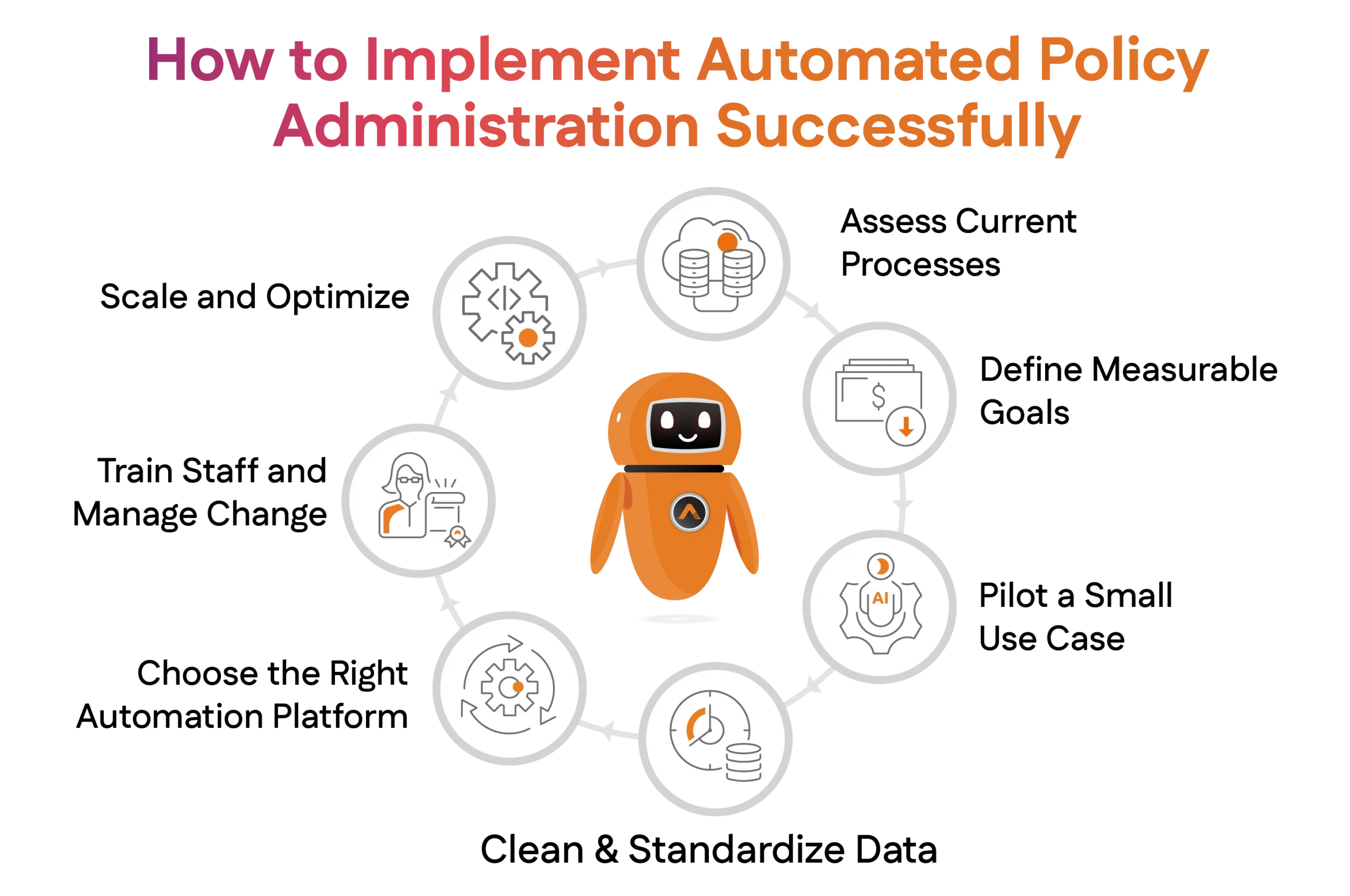
- Assess Current Processes: Identify pain points in underwriting, billing, or claims where automation can deliver the most impact.
- Define Measurable Goals: Set clear targets, such as reducing policy issuance time by 50% or cutting claims errors by 70%.
- Pilot a Small Use Case: Start with one department or product line to test automation before full deployment.
- Clean and Standardize Data: Ensure accurate, regulation-ready data to avoid errors in automated workflows.
- Choose the Right Automation Platform: Evaluate vendors based on scalability, compliance support, AI capabilities, and integration with legacy systems.
- Train Staff and Manage Change: Equip employees with training and set up support to reduce resistance.
- Scale and Optimize: Expand automation to other processes, track KPIs, and refine continuously for better ROI.
A well-structured roadmap ensures insurers gain the full benefits of automation without disruption. By starting small, focusing on data quality, and scaling strategically, organizations can achieve measurable improvements in efficiency, compliance, and customer satisfaction.
How to Choose Policy Administration Automation Tool for Insurers
Knowing how to choose a policy administration automation tool for insurers is critical for achieving long-term efficiency, compliance, and ROI. Not all automation platforms are built for complex, regulation-heavy insurance environments.
When evaluating a policy administration automation solution, insurers should consider:
- Integration with Existing Systems: Seamless connectivity with core PAS, legacy platforms, CRMs, document management systems, and third-party portals.
- AI Capabilities: Support for intelligent document processing, data extraction from unstructured files (KYC, proposal forms, endorsements), and AI-driven validations.
- Compliance & Governance Readiness: Built-in audit logs, role-based access, version control, and regulatory reporting.
- Scalability Across Policy Types: Ability to support multiple lines of business, such as life, health, and P&C insurance.
- Straight-Through Processing: End-to-end automation of policy workflows with minimal manual intervention.
- Low-Code Configuration: Faster adaptation to changing business rules and regulatory updates.
- Proven Insurance Use Cases: Real-world implementations that demonstrate measurable efficiency gains.
Manual vs Automated Policy Administration
Insurance policy administration can be managed either manually or through automation, but the difference between the two approaches is striking. Manual processes often lead to slower turnaround times, higher costs, and greater risk of error.
In contrast, automated policy administration powered by RPA and AI streamlines the entire policy lifecycle, making it faster, more accurate, and more customer friendly.
| Aspect | Manual Policy Administration | Automated Policy Administration |
|---|---|---|
| Time for underwriting | Days or weeks | Hours to a day |
| Error rate | Higher – manual data entry, human oversight | Minimal – AI/RPA checks & validation |
| Regulatory audit readiness | Harder – missing records, inconsistent updates | Easier – logs, automated compliance workflows |
| Cost of processing | Higher cost per policy because of manual labour | Lower total cost per policy, with efficiency and scalability |
| Customer satisfaction | Frustration due to delays and corrections | Higher due to faster, accurate service |
This comparison clearly shows why insurers are moving away from manual policy administration. By reducing errors, cutting costs, and speeding up processes, automated policy administration boosts efficiency and improves the customer experience. Insurers that adopt automation position themselves for long-term growth, compliance, and competitive advantage.
Benefits of Automated Policy Servicing for Insurers
The benefits of automated policy servicing extend far beyond cost reduction. Intelligent automation transforms how insurers manage policies, customers, and compliance at scale.
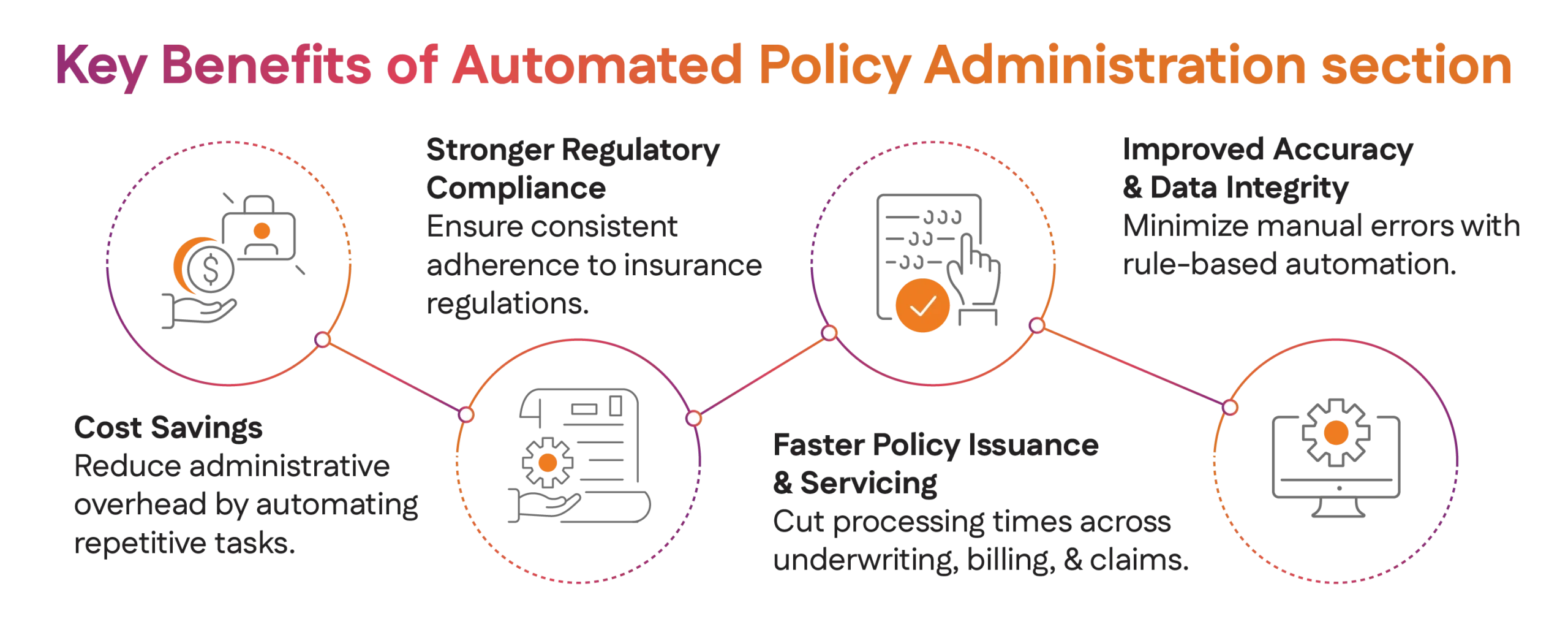
- Cost Savings: Reduce administrative overhead by automating repetitive tasks.
- Stronger Regulatory Compliance: Ensure consistent adherence to insurance regulations.
- Faster Policy Issuance & Servicing: Cut processing times across underwriting, billing, and claims.
- Improved Accuracy & Data Integrity: Minimize manual errors with rule-based automation.
- Enhanced Customer Experience: Deliver faster responses, seamless updates, and quicker claims settlements.
- Scalability: Support growing policy volumes without adding headcount.
While automation is already reshaping policy administration today, the future promises even greater transformation. Emerging technologies are set to take efficiency, accuracy, and customer experience to the next level.
Why Insurers Are Moving to Automated Policy Administration
Insurers are rapidly shifting to automated policy administration to:
- Eliminate manual inefficiencies across the policy lifecycle
- Improve compliance and audit readiness
- Reduce operational costs and processing time
- Deliver faster, more reliable customer experiences
- Scale policy volumes with consistent service quality
AI-powered policy administration automation enables insurers to move from reactive operations to proactive, data-driven decision-making—creating a competitive advantage in a digital-first insurance landscape.
AutomationEdge Advantage
AutomationEdge simplifies insurance operations by enabling end-to-end policy lifecycle automation, from quote to endorsement, renewal, cancellation, and reinstatement. It integrates seamlessly with core policy systems, legacy PAS, CRMs, document management tools, and third-party portals to deliver straight-through processing. This reduces manual handoffs, shortens cycle times, and helps insurers consistently meet policy turnaround SLAs, even for complex, rule-driven workflows.
In addition, AutomationEdge combines AI and RPA to intelligently process unstructured insurance documents such as proposal forms, KYC files, policy schedules, and emails. Built-in validations, business rules, and exception handling improve data accuracy and reduce rework, while compliance-ready features like audit trails, role-based access, and governance ensure regulatory alignment.
key Trends to Watch:
- AI-Driven Predictive Underwriting
Machine Learning (ML) models are enabling insurers to predict risks in real time by analysing large volumes of historical and third-party data. This allows underwriters to make more accurate and personalized decisions, reducing risk exposure while enhancing customer trust. - Chatbots for Policy Servicing
AI -powered chatbots and virtual assistants are transforming customer engagement. Policyholders can access instant self-service options to request policy updates, check billing details, or initiate claims without waiting for human intervention. This improves customer satisfaction and reduces support costs.
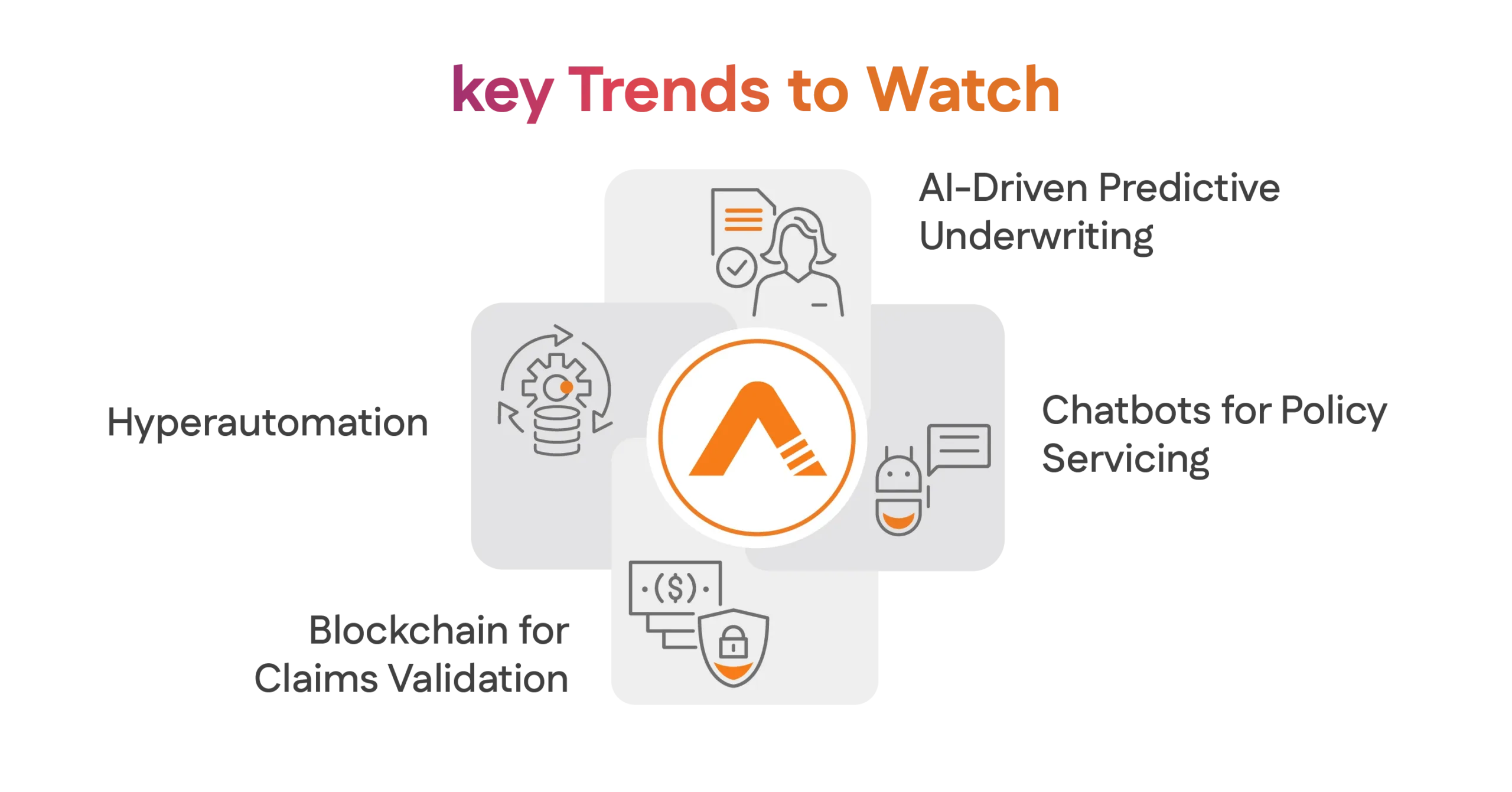
- Blockchain for Claims Validation
Blockchain is set to revolutionize claims processing by creating a secure, tamper proof record of policyholder data and claim history. This ensures transparency, reduces fraud, and speeds up validation, resulting in faster settlements and greater policyholder confidence. - Hyperautomation
Hyperautomation combines RPA, AI, analytics, and other digital tools to automate end-to-end policy administration. Instead of focusing on individual processes, insurers can optimize the entire policy lifecycle, achieving greater scalability, efficiency, and compliance across operations. These advancements indicate that automated policy administration is not just a short-term solution but a long-term strategy. Insurers that embrace these innovations early will be better positioned to stay competitive, ensure compliance, and deliver superior customer experiences.
Conclusion
Automated policy administration is reshaping insurance by leveraging AI in policy administration to make underwriting, billing, and claims faster, more accurate, and fully compliant. With intelligent automation, insurers can reduce costs, minimize errors, and deliver a seamless, consistent experience to policyholders.
With emerging AI and RPA technologies, efficiency and customer satisfaction continue to grow. Transform your policy operations today with AutomationEdge and unlock smarter, faster, and more reliable insurance management.
Frequently Asked Questions (FAQs)
The post Automated Policy Administration for Better Operational Efficiency appeared first on AutomationEdge.
This is a companion discussion topic for the original entry at https://automationedge.com/blogs/automated-policy-administration/